Header tag

Wednesday, 3 June 2020

Review: Space Force, Episode 2: "Save Epsilon 6!"

CONTAINS SPOILERS

The second episode of Space Force follows immediately from the first episode; with General Naird and Doctor Mallory witnessing (via an implausibly powerful telescope) the sabotage of the Epsilon 6 probe they had just launched.


There's an F-bomb from each of them, before they return to mission control to work out what's happened and what can be done about it.  It seems the language in this show is the only thing that's definitely strong, because the characters, plot and script are definitely not quite there yet.


This episode focuses on the struggle to reattach the two solar panels to the Epsilon 6 probe - there's problem-solving, brainstorming and so on.  The struggle is largely between the inept but in-charge General Naird, and the sensible but obstructive scientists (we meet more of them in this episode).  The General wants to use a bomb to blow the solar panels back onto the probe (there's a convenient plot device which states that the panels only need to touch the probe to work).  After all, in the Air Force, using a bomb is always the best answer - is that a political comment, or is it funny; neither, or both?
The scientists want to try a more elegant approach, which is, in all honesty, probably more likely to succeed, and they are conveniently sidelined.  This episode is about the relationship (or lack of it) between Naird and Mallory, and the pressurised situation of trying to rescue the Epsilon 6 is a good background for it.  Both men have skills and knowledge that the other needs, but neither of them will accept that yet.

One character who is not conveniently sidelined is the social media marketing idiot, Tony.  I'm sorry, but he brings nothing to the story at all, and if anything, he detracts from it.  He is an obstruction to the story and the plot, and a distraction from the better characters (as in, all the other characters).  He needs toning down or kicking out.  At the end of the last episode, Naird had put him in jail, which worked for me.  Sadly however, in this episode, he's back and getting in everybody's way.

The final solution that Naird proposes is to use a monkey from a nearby orbiting spacecraft (convenient, but it works) which was recently launched, and get it to fix the Epsilon 6's solar panels.  Cue visual comedy about communicating with a very unhappy monkey through sign language, and finally persuading it to fix the Epsilon 6.  The visual comedy reached farcical proportions as the monkey used a power drill/power screwdriver to reattach the solar panels - when the bolts stopped turning, the laws of physics dictate that the drill needs to start turning instead, and the monkey (still holding the drill) starts spinning around at several hundred rpm.  Which is funny enough, until the monkey lets go and is launched into space.  Hmmm.

The Epsilon 6 is fixed.  However, the monkey is now on a collision course with the Sun, and so the brainstorming switches to 'how do we get the monkey back?'.  The question is rendered moot by the end of the episode, as the Chinese space vessel (which had sabotaged the Epsilon 6) has completed an orbit, and intercepts the monkey.  Coincidence?  Farce?  Yep.

The episode concludes with the team working out how to escalate this international (interplanetary?) incident... we shall see.

I rate this episode marginally better than the first, but if things don't improve, I'll find myself returning to planet earth and finding something else to watch.  7.5 out of 10.


Saturday, 30 May 2020

Review: Space Force: Episode 1

Space Force:  is it a mockumentary?  Is it a sitcom?  Is it just plain funny?  To classify it, I'd call it a sitcom, bordering on farce.

Steve Carell is definitely funny.  He knows comic timing and how to deliver a gag - physically and verbally. But this is not The Office. And one thing I will include at this point is that the language in Space Force is unnecessarily bad - the series is rated 15 for language and it shows. It's almost as if the producers realised their show isn't laugh-out-loud hilarious and threw the profanities in to compensate.

Anyway, back to the comparisons.

Michael Scott is accidentally competent, unaware of how his team's success is their own work, and often despite his management, rather than because of it.  His career is largely successful (best branch in the company) and this success allows him a lot of leeway in using his own personality to manage.

General Naird is largely unsuccessful despite all his best efforts. He has almost no control over his life: he's been given a promotion to a four-star general rank, and despite expecting to take on leadership of the Air Force, he's been given the task of founding and running Space Force. He's totally out of his depth.

He has no control over his family life: for reasons not yet revealed, his wife is in prison. His daughter is pushing his boundaries and she's started dating a Russian astronaut stationed on the space base.

He has no authority over his space programme, despite being responsible for it. He wants to launch a rocket, but the resident  head of science (an annoying character played by the typecast John Malkovich) says he can't due to bad weather.

He even has no control over his office: in the first episode, there is an unannounced and uninvited guest in his office every time he walks into it (except one occasion, where he escapes to his happy place).  His personal assistant or receptionist or however you'd like to refer to him, is an incompetent waste of space.

The General feels the pressure of his space programme ("Boots On The Moon") at all times, and in contrast to Michael Scott where he's an appalling manager with a successful team, the General is a good manager (out of his depth) surrounded by critics, detractors and obstructions.

So, Space Force is nothing like The Office.

The first episode could be summarised as "General has to demonstrate some return on all the investment into Space Force, and in order to do so, prematurely launches a prototype weapon which explodes on the pad, but contrary to scientific advice, successfully launches a new unmanned rocket into orbit." with a twist, "Another spacecraft severs the new probe's solar panels leaving Space Force with a predicament to solve."  It introduces the main character and his colleagues, who are some of the most irritating characters on Planet Sitcom.  I've already mentioned John Malkovich's character, Dr Adrian Mallory (as annoying as he was in Transformers Dark of The Moon); joined by F. Tony Scarapiducci (played by Ben Schwartz, who played the utterly infuriating John Ralphio in Parks and Recreation), who is the entirely superfluous social media manager.


Is Space Force funny?  In parts, yes, but not in the way that The Office is funny, or Parks and Recreation, or any other mockumentary or sitcom.  If anything, I'd have to liken it to the more serious episodes of Brooklyn 99, but without the slapstick.

One thing it certainly has is accidental relevance. In a week where the Space X Dragon launch was postponed due to the weather, this was very timely.  The handover of Space Force to General Naird is accompanied by the line that The President wants to protect the Internet and Twitter as information is bounced off satellites.  In a week where Donald Trump has loudly attacked Twitter, this was certainly an unplanned piece of cultural commentary.

Do I like it? I think so, but I am not convinced. The tone of the General constantly under pressure to perform does  not lend itself easily to comedy, and apart from wastefully spending taxpayers' money in failed launches, there's not much to laugh at in the first episode.   I'm rating it 7 out of 10, and will persevere for another few episodes at least.  I even managed to make it as far as watching and reviewing Space Force Episode 2.

Wednesday, 27 May 2020

Crazy Blitz Chess

Chess is a complex game - sometimes you win, sometimes you lose; sometimes you deserve to lose and still manage to win.  This is probably the craziest game of Chess I've played - Blitz again - but I was very pleased with the way I wrapped it up.  Firstly, the step-by-step video replay:


I played White, and selected my standard Queen's Gambit opening.

White "davidleese1010"  vs Black "tarekamine"

1. d4     d5
2. c4     Nc6 
3. Nc3   Bf5
4. Qb3   Na5
5. Qa4+   c6
6. cxd5   e6
7. e4   exd5
A blunder from which Black never really recovered.  

8. exf5   Qe7+
9. Be3   Nc4
10. Bxc4  dxc4
11. Qxc4  Nf6 
12. Nf3   Ne4 
13. O-O   O-O-O 
14. Rfe1  Qd6 
15. Nxe4  Qc7 
16. Ne5   Rd5
17. Rad1  f6 
18. Nf3   Rxf5 
19. d5   cxd5 
20. Qxc7+ Kxc7 
21. Rc1+  Kb8
22. Red1  

Setting a cheeky trap.  Black cannot capture because Rd8 is checkmate.  And now, I've centralised both my rooks.

22. ...   Bb4 
23. Nc3   Rd8 
24. Nd4   Rh5 
25. a3   Bd6
26. b4    Bxh2+ 


Missed that one.  But at least I have an easy escape square, and now my pieces gravitate towards Black's King.

27. Kf1   Be5 
28. Ncb5  a6 
29. Ne6   Rd7 
Forcing Black's Rook off the back rank, with my Rook on c1 now waiting.


30. Ba7+  Ka8
31. Rc8+  1-0

Final position: my pieces are so precariously placed that my only option was to keep moving forwards at maximum speed!


Some of my other Chess games:

My very earliest online Chess game
My most bizarre Chess game
My favourite Chess game


Thursday, 21 May 2020

Reckless Chess for Fun

Way back when I first started this blog, it was going to be a place where I shared my games of Chess.  Over the years, it's changed - the name has changed twice, and the content has changed constantly, although it does tend to gravitate towards maths and web analytics (and Star Trek).

Here's a recent one-off Chess game - five minutes of Blitz.  I was Black, and I was clearly in a reckless mood:


Starting with move 9. Bh5, where I deliberately allowed my bishop to become trapped.  Yes, it was deliberate.

1. d4 d5  
2. Nf3 Nc6
3.  e3 Nf6  
4. Bd3 g6  
5. O-O Bg7  
6. b3 O-O  
7. Bb2 Re8  
8. Nbd2  Bg4  
9. h3 Bh5 
Reckless, but with the deliberate plan of getting two pawns for the knight, then opening up White's king with ... e5 and Qg5 or Qh4

10. g4 Nxg4
11. hxg4  Bxg4  
12. Qe1 e5
13. dxe5 Nxe5
14. Bxe5  Bxe5  
15. Nxe5  Rxe5


Recapturing in the centre, with my queen now ready to sweep into the kingside.  I have, however, missed an opportunity since White's move 12 Qe2 to play Bh3 and trap White's rook.  This is blitz Chess, and such mistakes are not uncommon.

 
16. Be2 Bh3  (I saw it!)
17. Bf3 Qg5+
18. Kh2 Bxf1 (finally capturing the rook, bringing the game closer to material parity) 
19. Qxf1  Qh4+  
20. Kg1 Rg5+  
21. Bg2 Rh5
22. Nf3 Qf6
23. Qe2   Re8?  (missing the chance to play Qxa1, but bringing in reinforcements)

24. c3 Qxc3  
25. Rd1 c6  (I couldn't think of anything better than this solidifying move)
26. Qd3  Qb2  
27. Qd2 Qf6  
28. Qd4  Qf5  
29. Qxa7  Re4 

I have decided to play some more reckless Chess.  I don't need those pawns, I need to launch my pieces at White's King - now!


30. Qb8+ Kg7  
31. Qg3    Rg4  
32. Qe5+  Qxe5

I didn't want to exchange Queens, but I had to - White had been pushing to trade for several moves, and here he managed to force the exchange.
 

33. Nxe5  Rxe5  ... but I got an extra knight for it, and now I'm ahead on material, and have an outside passed pawn ready to roll.
34. Kf1 f5  
35. Ke2 Rxg2  a blunder from white, which I didn't miss.  This is now winning for me.
36. Kf3 Rg4  
37. Rc1 h5  
38. a4 h4    "Always push passed pawns"
39. Rh1 g5  
40. Rh2  Rge4  
41. Ke2 f4  
42. Rh3 d4
43. Kd3 dxe3
44. fxe3  fxe3
45. Ke2   Rd5 

A very pleasant position for me.  I'm going to play Rd2+ and keep pushing the e-pawn, and I've got the g- and h-pawns too.  My opponent's next move surprised me.


46. Rxe3  Rxe3+  

47. Kxe3  h3   and now, apart from dodging any stalemate traps, it's plain sailing.
48. Kf3 h2  
49. Kg2 Rd2+  
50. Kh1 g4  
51. b4 g3  
52. b5 cxb5  
53. axb5  Rd1+  
54. Kg2 h1=Q+  

I won't annotate the rest, but rest assured I wrapped up the game in the next five moves.

And here's the full PGN file of the game.

Reckless Chess - it's the way forwards!

Some of my other Chess games:

My very earliest online Chess game
My most bizarre Chess game
My favourite Chess game

Tuesday, 28 April 2020

Summing Square Numbers and Triangle Numbers

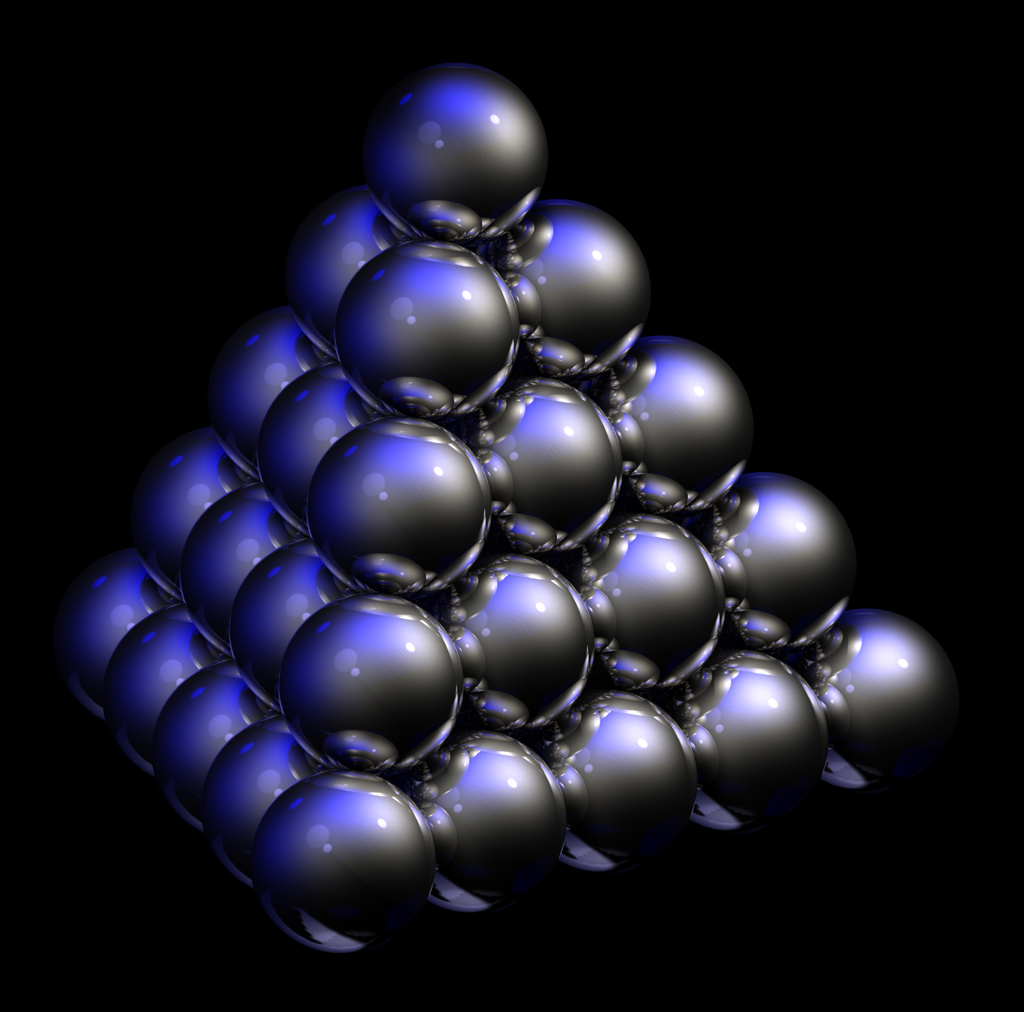
"A grocer stacks apples in pyramids made of layers of equilateral triangles. How many apples will he need to fill four levels of apples?  A second grocer stacks apples in pyramids made up of layers of squares - how many apples will he need to fill four levels of apples in each tower?"

Firstly, let's borrow a picture for the first grocer's tower - this one contains the first five layers.


This is the series of triangle numbers:
The first row is one apple
The second row is three apples

The third row is six apples
The fourth row would be ten apples
Total = 1 + 3 + 6 + 10 =20 apples

And for the second tower, which is the series of square numbers:


The first row is just one apple.
The second row is four apples
The third row is nine apples (three squared)
And the fourth row would contain 16 apples (four squared).

1 + 4 + 9 + 16= 30 apples

These are the two ways of most densely packing spheres - in triangular fashion (left), or in a square fashion (right).  I've covered the density of sphere packing in hexagonal planes in a previous blog.

Extension Task

Now, to extend this simple problem a little further:  how many apples would be needed to produce a triangular tower (like the first grocer), or a square tower (like the second grocer) with n rows?

We need to determine expression for the nth term, and we can do this by taking differences between adjacent terms, and then the second (and if necessary) the third difference.

Triangular Tower (Tetrahedral)

The terms for the total numbers of apples are 1, 4, 10, 20, 35, 56 and so on.
The first difference is 1, 3, 6, 10, 15, 21 (the triangular numbers)
The second difference is 1, 2, 3, 4, 5, 6
And the third difference is 1, 1, 1, 1.

The third difference means that this is a cubic expression, and the value of the third difference (1) needs to be divided by 6 to give the coefficient a in the expression ax3 + bx2 + cx + d
Hence we know that the expression is x3/6 + bx2 + cx + d

We now have to subtract x3/6 from each of the xth value, and calculate the differences again (to determine what the coefficient b is), and then repeat the process to determine c.

Following this process, we can see that the expression for the nth term is

Tetrahedral Tower:  Tn = n3/6 + n2/2 + n/3

The Twelve Days of Christmas

This has one practical application:  if you recall the song 'The Twelve Days of Christmas', you'll see that each row, starting at the top, is the number of gifts given by 'my true love'.  On the first day it's 1, on the second it's 2+1, and on the third day it's 3+2+1, and so on.  So, if you're ever asked the question, "How many gifts in total were given during the twelve days of Christmas?" then you can whip out your calculator:  123/6 + 122/2 + 12/3 = 1728/6 + 144/2 + 12/3 = 288 + 72 + 4 = 364.

Square-based tower

The terms for the total numbers of apples are 1, 5, 14, 30, 55, 91 and so on.
The first difference is 1, 4, 9, 16, 25, 36 (the square numbers)
The second difference is 1, 3, 5, 7, 9, 11
And the third difference is 2, 2, 2, 2.

The third difference means that this is a cubic expression, and the value of the third difference (2) needs to be divided by 6 to give the coefficient a in the expression ax3 + bx2 + cx + d

Hence we know that the expression is x3/3 + bx2 + cx + d

We now have to subtract x3/3 from each of the xth value, and calculate the differences again (to determine what the coefficient b is), and then repeat the process to determine c, and d if needed.

Following this process, we can see that the expression for the xth (or the nth) expression is

Square-based Tower:  Tn = n3/3 + n2/2 + n/6

(As an aside, these solutions remind me of the puzzle I solved last year: 1/a + 1/b + 1/c = 1)

Other posts similar to this that you may be interested in:

The Fibonacci Series
Pythagorean Triples
Ulam Sequences: Up, Up and Away


Sunday, 19 April 2020

More on Dice Games, Probability and Distributions

In a previous post I've analysed probability distributions from rolling two dice: looking at the sum of two dice (a well-known distribution), the difference; the largest of two dice and the smallest.  This article comes about following some home-schooling I've been doing with my children, looking at distributions of results for throwing one or two dice - this was an extension activity we looked at (and I'm examining it in more depth here).

In this article I'm going to examine a different distribution: rolling three dice and summing the two largest dice. This is clearly going to be skewed towards larger totals than the normal two-dice distribution- but by how much, why, and what does this distribution look like?

For example, there is only one way to get a sum of 2, which is to roll 1 1 1. However there are many ways to get 12, including 6 6 3, 6 6 2, and 6 6 1.

To abbreviate the analysis, I'd like to show and use the following results:

There is only one way to roll 1 1 1, 2 2 2 or 3 3 3.  This is self-evident but worth mentioning.


When one of the dice has a different value to the other two, there are three equivalent combinations: 4 4 5 is equivalent to 4 5 4 and 5 4 4. For any a a b, there are three equivalent combinations.

When the dice have three different values,  there are six equivalent combinations: a b c, a c b, b a c, b c a, c b a and c a b.

Onto the actual distribution, then:


Score List


2 1 111 1


3 3 211 3


4 7 222 1 221 3 311 3


5 12 321 6 322 3 411 3


6 19 333 1 332 3 331 3 422 3 421 6 511 3


7 27 433 3 432 6 431 6 522 3 521 6 611 3


8 34 444 1 443 3 442 3 441 3 533 3 532 6 531 6 622 3 621 6
9 36 544 3 543 6 542 6 541 6 633 3 632 6 631 6


10 34 555 1 554 3 553 3 552 3 551 3 644 3 643 6 642 6 641 6
11 27 655 3 654 6 653 6 652 6 651 6


12 16 666 1 665 3 664 3 663 3 662 3 661 3


Total:  216   = 6*6*6 

The distribution is clearly skewed to the higher values, compared to the two dice distribution.  This makes sense, we're selecting the two largest values from three dice. Interestingly, it's not even symmetrical either side of the mode of 9 - the values for 8 and 10 are the same, as are 7 and 11, but there are fewer ways of getting 12 compared to 6.

Here's the breakdown, which compares to "seven for everything" for the normal two-dice distribution.

Mode = 9
Median = 9

Mean 8.458

Comments:

In game design, if you want a character, figure or unit to move generally faster or perform better than a typical two dice distribution, then taking the two highest values from three dice will certainly achieve this, while still retaining a range of 2-12 spaces or points.  Your unit will hit harder, but can there's still a possibility that it will be outperformed by a two-dice unit.

If you're interested in probabilities, I have a few articles you may be interested in:  the probability of getting a set of toys from blind bags; which expanded over four articles; and Isaac Newton's Random Walk.

Saturday, 28 March 2020

Review: Star Trek Picard, Episode 10: Et in Arcadia Ego, Part 2

CONTAINS SPOILERS

Last week's episode, 
Et in Arcadia, Ego - Part 1, moved all the players into position:


Picard is under house arrest in Synth City, with Dahj free to move around, and Agnes helping Dr Soong with his work
Raffi and Rios are repairing the La Sirena, but I doubt it will fly anytime soon
Seven and Elnor were on the Borg cube, which is also stuck on the ground
Narek was making his escape to the Borg cube (expecting it to still be under Romulan control - I don't rate his chances of survival)
The synths were preparing for the Romulan attack - which is coming at maximum warp, Commodore Oh at the helm - and hoping to contact the extra-galactic synths who will save them from their evil organic overlords.

Also in play is the 'golem' - the android body without any consciousness - waiting to be used (probably) as a replacement body for one of the organics who suffers severe, catastrophic injuries during the upcoming battle.  The question is:  who?

Then there's the Federation fleet at Deep Space 12; presumably also too far away to be of any use (not withstanding that Picard has failed to make contact with Starfleet).  It all looks bleak.

The episode opens with Narek returning to the Borg cube, as I had anticipated.  Due to the first of many questionable plot developments, nobody on the cube notices his arrival, or that he steals twelve molecular solvent grenades.  Nobody, that is, except his sister Narissa, who was last seen struggling beneath a pile of angry and violent xBs, and who we all assumed had died in the fight.  What's more, the plot requires that all of the key characters (including Narissa) survived the fall from space to the planet without any real injuries.  While watching this, I wondered if Narissa was just a projection or a hallucination from Narek, but no.  The worst part of this scene is that Narek escapes with the grenades, very closely followed by Elnor (who later appears to be several minutes behind).  I have to say that the writing in this episode was completely inconsistent with the general good-to-high quality we've had throughout the series - there are gaps you could pilot a starship through).

Soji and Picard have their usual number of philosophical discussions, the highlight of which is Picard's line: "To say you have no choice shows a lack of imagination."

Rios and Raffi decide to use the synth device to fix the intermix reactor (think of it as the combustion chamber in the cylinders of a car engine).  Rios was given this device by Saga, who was the synth who was murdered last week - the naïve prison guard.  Anyway, in order to use the device, Rios needs to use his  imagination (there's that word again), and, as if by magic, the intermix chamber is repaired, and the whole ship miraculously goes from non-functional to flight-ready.  At which point, Narek starts lobbing rocks at the hull of the ship.  Where's Elnor?  He was barely five or six seconds behind Narek when they left the cube, but suddenly Narek is able to have a discussion with Rios and Raffi while Elnor plays catch-up.  Hmmm.

Anyway, Narek recounts Romulan mythical history about two sisters (not unlike Soji and Dahj) who are basically the harbingers of doom.  Seb-Natan, the first sister, warns of impending doom, while the second sister, Seb-Cheneb will actually cause the evil "ch'kalagu" to come from a split in the sky.  It's all very apocalyptic.  Narek explains that this "Is history.  But the fascinating thing about history is that it always repeats itself," and hence recruits Rios, Raffi and Elnor to his cause - to stop the synths from bringing the end of the world as we know it.  He concocts the classic prisoner plan (Luke Skywalker tried the same trick with Chewbacca on the Death Star; Princess Leia tried the same trick - also with Chewbacca - on Jabba's palace on Tattoine), and we see the team make a successful start on their plan.

Agnes decides it's time to rescue Picard from house arrest, and steals poor Saga's eye in order to open the secured locks on the doors.  The rescue actually proceeds without a hitch, even when Agnes delivers the fateful line, "I honestly thought I was the worst secret agent ever, but I'm honestly believing I have a gift."  I truly expected Sutra, or another synth, to appear in the doorway at that moment!  The two of them make it successfully to the La Sirena, where Picard delivers another brief speech: "Fear is an incompetent teacher," before piloting the ship up to meet the Romulan fleet.

Narissa, on board the remnants of the Borg cube, starts to track and target Picard's ship, until she is interrupted by Seven. The two of them have a brief fight, ending with Seven shoving Narissa off a precipice, which is a standard sci-fi device for 'really dead this time'.

Dr Soong, meanwhile, is able to access Saga's final memories and realises that she was killed by Sutra (I figured it was Narek) and goes to confront Sutra and the other synths.  On his way, he meets up with the crew of the La Sirena, who are preparing to throw a grenade at the base of the beacon which Sutra is building.  The beacon is a tall, metallic tower, also being grown by synth magic, and the grenade needs to be thrown at its base (according to Narek, who suddenly knows a lot about trans-dimensional beacons).  Soong provides a distraction by confronting Sutra and either stunning or deactivating her, while Rios struggles to get a clear shot at the tower. He tries and fails to hit the target- Soji intercepts his throw - and the beacon is completed. This is all very reminiscent of the Marvel universe where Loki opened up a rift over the skies of New York - even the incoming aliens looked familiar.

The Romulans arrive in the space above the planet, met by Picard and the flying orchids. It's bright, it's colourful and it's all a delay tactic while Picard Hope's that Starfleet can make it.  Picard is indeed a very rusty pilot and his antics at the helm are amusing.  Agnes asks him about using "The Picard Manoeuvre" which is a real throwback.  If you jump to warp and fly towards an enemy ship very, very briefly, you will arrive closer to the enemy ship before the light from your starting position, and hence appear to be in two places at once. As Picard explains, it was a long time ago, on his very first ship, the Stargazer (see The Next Generation episode "The Battle").

Instead, Agnes is able to use the synth magic wand to produce dozens of projections of the La Sirena, which buys Starfleet and the synths even more time. As I immediately thought, this kind of trick only works as long as the real ship isn't damaged: the Romulans get a lucky shot off and hit the La Sirena and the whole deception is off. Not to worry though, here comes Starfleet! With a suitable degree of fanfare and ceremony, we see the massed ranks of Starfleet arrive - big, grey with red and blue lights and unmistakably heroic.  At the helm? Captain Riker, fresh out of retirement.

The standoff between the two fleets is handled well, even if it looks a little too much CGI'd. I suppose 400+ ships is a lot for any studio to render.  It gives Picard the time he needs to plead his case with Soji, who agrees to close the portal - and just in time, too, as the transdimensional baddies were on their way.  It's all last-minute cliff-hanger material but it all seems a bit obvious (I would have liked to see the joint fleets take on some of the evil synth fleet, but that would be difficult to show with 400+ ships plus the aliens. The writers backed themselves into a corner there).

All this stress and strain has caused Picard's brain disease - irumatic syndrome - to flare up and, as the Romulans stand down and fly off, Soji beams Picard and Agnes back down to the planet as a medical emergency.  Since nobody has died, the rest of the episode goes through the steps of Picard dying, having his brain transferred to the synth blank, and being reborn as an android. The conversations between the crew lacked any emotional depth as we all know Picard isn't really dead, but there were some nice touches.  I liked Rios and Seven's conversation - "Never again," - each with their own regrets, Seven winning as she had the power to change her actions and avoid what she now regrets.  I wondered if these two might start a relationship, but I completely missed the mark.

There is an extended after-life scene between Picard and Data on the nature of mortality and life, concluding with Picard gaining consciousness in his new, not-improved, not-immortal, basically-the-same-as-before body.  I was hoping for more than the status quo, and I sincerely hope that something is made of this new body. 

Before his death in Star Trek Nemesis, Data transferred a full copy of his memories into a blank android called B4 (which we saw briefly, disassembled, in an earlier episode). Data has survived in this copied form - consciousness only - in the lab on the synths' planet, and Picard agrees to switch off this life-support system.  From Data's perspective, we see him getting older and more of his surroundings disappear until he and the original Captain Picard disappear.

The epilogue sees Rios and Agnes pair up, and Seven pair up with Raffi (See? I was way off the mark). Soji rejoins the crew, along with Elnor, and Picard sets off for the great unknown (second star to the left?).

I'll wrap up with some questions that highlight some of the holes in the plot and demonstrate why I only rated this episode as average.

Will Agnes face charges for killing Maddox?
What happened to Narek, last seen on the planet?
Is Picard in any way different now??
Will Elnor get any depth? Seven and Rios had a conversation; Elnor just cried on Raffi - is there nothing more to him?

So, overall very positive.  A lot of setup, which seems to be the new approach to televised sci-fi, instead of a starter episode and subsequent standalone episodes. I am certainly looking forward to series 2.  My articles on series 2 start with an analysis of the season 2 preview trailer.