Header tag

Sunday, 27 February 2011

Physics discussion: Escape Velocity

The story goes that Isaac Newton was sitting under an apple tree, when an apple fell on his head, and prompted him to wonder why it fell downwards, and not upwards or even sideways.  However, what history doesn’t tell us is that he probably got quite upset at having his afternoon nap interrupted by an apple, and, in his annoyance, threw the apple away as far as he could, declaring, “Stupid apples!”  He then wondered why the apple fell back to the earth, despite him throwing it away as hard as he could.

The same applies today (gravity hasn't changed much since then).  Consider throwing a tennis ball:  the harder you throw it, the higher it goes.  How about throwing it upwards, or even aiming for the moon (it’s not a million miles away, you know)? How fast does it have to be travelling, or how quickly do I have to throw it, so that it doesn’t come back down again?  We call this initial speed (how fast you have to throw it) the escape velocity.

Thinking in scientific terms, we can say that the apple (or the tennis ball) has escaped from the Earth’s gravitational pull, and will not fall back down to the earth.  It has maximum gravitational potential energy, and no kinetic energy (i.e. it stopped moving).  This happens at the edge of the gravitational field.

Since the kinetic energy at the start (i.e. from the throw) has all been converted into potential energy, we can say that the two are equal.

The potential energy is:
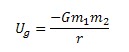
And the kinetic energy is:
where m2 is the mass of the object being thrown, and m1 is the mass of the Earth. 

 I’ll explain a bit more here about how this works, because at school I was taught that gravitational potential energy = mgh¸ where m is mass, g is acceleration due to gravity, and h is height – so that potential energy continues to increase with height.  So, when does PE = mgh stop being correct?  PE = mgh is not true when h becomes large, and g becomes very small.  The value of g changes with height; close to surface of the earth, mgh is an acceptable approximation, however at high altitude, g becomes
very much smaller.  It’s different at the top of a mountain than it is at sea level for instance.
So, the definition of potential energy is something else, it’s not mgh, it’s taken as something else.PE for all locations is equal to the formula given above.

Since we can equate these two energies, we have that:

Solving for this revised equation gives an expression for escape velocity, v, as:


Where m2 is the mass of the Earth (in this case) and r is the Earth’s radius from centre to surface (i.e. from the centre of gravity to the point we’re launching from), since we have a bit of a head-start on gravity (we don't have to launch from the centre of the Earth).

Solving for all the numbers gives us an escape velocity of 11,181 metres per second, which is 34 times the speed of sound (Mach 34).  If you tried to throw an object at this speed, you'd probably either break your arm, or suffer friction burns from the air resistance as the air particles tried to move out of the way of your arm (and failed).  
It's also worth mentioning that I've not looked at air resistance, which at Mach 34 is considerable.  The sonic boom caused by the apple (or the tennis ball) would be extremely loud... in fact, I imagine the apple would turn into apple sauce, and the tennis ball would melt into a sticky, furry goo before it got anywhere near earth orbit.

I should explain at this point that escape velocity isn’t the speed that space rockets travel at when they take off.  This is really important.

An important point about escape velocity

Remember at the start that we were talking about throwing objects – where all the energy, and force is transferred to the object at the start of its flight.  With space rockets, the engines keep pushing the space rocket while it’s in flight, so they don’t have to travel as quickly, they just have to push upwards with a force that constantly exceeds their weight until they achieve an earth orbit.  This means that space shuttles, and space rockets, don't have to reach escape velocity.  Instead, they just have to keep pushing upwards with a force that is greater than their weight, until they reach an orbital height.


Friday, 25 February 2011

Astronomy 1: Stars, Planets and Moons

Following last night's visit to Keele Observatory, I thought it might be helpful to cover some of the basics of astronomy, and then move onto some more detailed topics.  Everybody's got to start somewhere, so I figure it's best to start with home, and move on from there.

The Earth spins on its own axis, taking one day to complete one revolution (one full turn).  This gives us day and night.

The Earth orbits (goes around) the Sun, going around the Sun in one year.  One year is 365.25 days.

Stars:  Stars are huge (very, very big) balls of gas that are carrying out nuclear reactions.  It might be easier to think of a star as an enormous nuclear reactor, constantly going out of control.  The Sun is a star.

Planets:  Planets are smaller balls of rock or gas that go around stars.  There are nine planets that go around our star, the Sun.  The nine planets are Mercury, Venus, Earth, Mars, Jupiter, Saturn, Uranus, Neptune and Pluto (going in order from nearest to the Sun to furthest away).  

Moons:  Moons are smaller than planets, and go around planets in their own orbits.  Our Moon goes around the Earth in just under 28 days; some planets (such as Mercury and Venus) have no moons, while other planets (such as Jupiter and Saturn) have over 10 moons each.

One of the basic principles of astronomy is that smaller (lighter) objects go around larger (heavier) objects, and that's all due to gravity.  Galileo, who was one of the first people to make serious use of a telescope, saw Jupiter and four of its moons going around it, and started to wonder if the Earth goes around the Sun.  It wasn't a popular theory at the time, but a serious step forwards in our understanding of astronomy.

Our star, and its nine planets, are all part of a bigger group of stars (about 10 billion stars, roughly) that are all held together by gravity, in a group called a galaxy.  Our galaxy is called the Milky Way.  It's called the Milky Way because, if and when you can see the faint stars in our galaxy in the sky, they look like a milky cloud stretching across the sky.  Almost all of the stars that we can see in the night sky are in our galaxy.  Our nearest neighbouring galaxy is called Andromeda, and in the right conditions, it can be seen without a telescope or binoculars.

Why don't the planets crash into each other?
Because they're all going around the Sun at different distances.  Mercury is closest to the Sun, and completes one orbit in 88 Earth days, while Pluto, which is furthest away from the Sun, takes 220 times longer than the Earth to go around the Sun.

What is a light year?
A light year is a measurement of distance, and it's equal to the total distance that a ray of light would travel in a year.  The speed of light is 300,000,000 metres per second, or 186,000 miles per second, and there are 31 million seconds in a year (60 seconds in a minute, 60 minutes in an hour, 24 hours in a day, 365.25 days in a year).  This means that in 31 million seconds, light would travel 9,467,280,000,000,000 metres, or 9,467,280,000,000 kilometres, and this distance is called a light year.  The distances in space are so far, that we need a meaningful measurement that we can use to compare distances between objects.  

The Sun's nearest neighbour is called Proxima Centauri ("proxima" meaning "close") and that's 4.22 light years away.  This means that light shining from Proxima Centauri takes just over four years to reach us, and that means that we're seeing what it looks like four years ago.  This, it is true, is a very strange situation, and that's because we're used to looking at objects that are much closer, where we can assume that we're seeing things as they are now (because the speed of light is very, very fast, and it takes fractions of a second for the light to travel from the object to our eyes).

I should make it clear that a light year (despite its name) is not a measurement of time, it's a measurement of distance!

In my next post, I'll try and move onto some more specific details, and answer a few questions that I've heard or been asked about astronomy.


Wednesday, 23 February 2011

Port Vale 1 Stevenage 3

I rarely watch football on the television, and it’s rarer still that I watch a live match; until yesterday, the last one was at least two years ago.  However, last night, as a result of my wife winning a prize draw, I went to see my local team, Port Vale play at home against Stevenage in a league fixture postponed from early December, when the pitch was frozen.

If you’re looking for a well-informed analysis of the game, I’d suggest looking elsewhere – I stopped watching football when it moved from terrestrial television to Sky, several years ago.  However, I can still make some comment on how the game developed, and what happened – call this an eyewitness account rather than a detailed commentary.

Stevenage started the game playing something like a 4-5-1 formation, with their number 10 playing pretty much as a lone striker against the Vale defence, and defended deep against Vale.  For the first 20 minutes or so, Vale had most of the possession, but were unable to do anything constructive with it; one long-range shot from outside the box, which went wide, was about the best they could muster.  It appeared that Stevenage were going to play for a goal-less draw, and it certainly looked as if they were going to hold Vale without much difficulty.  Vale lacked any sense of urgency or attacking strength, while Stevenage’s lone striker was having very little success against the Vale back line.

After half an hour, Vale seemed to have settled in possession, until one of the midfield players, possibly realising he had no clear way forwards, played a back pass from just outside the centre circle to the goalkeeper.  His pass was well weighted, but one of the Stevenage strikers fancied a look at it and started chasing it down, accompanied by his Vale marker.  In the end, however, they both gave up as the ball continued back to the keeper.  However, on its way back, it hit a divot about 10 yards from the goal line which took it slightly off course and straight past the unbalanced Vale goalkeeper into the net.

In almost all football matches I’ve watched, the moment the ball hits the back of the net is accompanied by a huge roar from the crowd and widespread celebration among the fans and players.  This goal was met by a stunned silence – from all the players and the crowd.  Stevenage brought around 100 fans, who were at the far end of the ground, and I don’t think they could quite believe what they’d just seen.  The Vale fans certainly couldn’t.

I was surprised that Vale didn't immediately start attacking with more enthusiasm, and seemed to settle back to their prior pattern of passing it around with no real sense of direction.  As the game progressed, however, they started to build an attack... much to their own downfall.  The ball broke along the Stevenage right wing, and their right back, number 2, chased it down, sending the Vale left back, number 15 Collins, back to cover.  However, the Stevenage defender beat his man and went charging down the right wing, delivering a good cross across the middle of the penalty area, until it went to the far post, and the resulting shot beat the advancing goal keeper.  The Stevenage players were very pleased with their first 'genuine' goal, and celebrated with some gusto.

The players were booed off the pitch at the end of the first half, and the highlight of the half-time break was an appearance by an ambulance who had to take one of the Vale fans off to hospital.  It was during the break that I started to understand the depth of feeling against the new manager, Jim Gannon.  The ambulance turned up; "Taxi for Gannon!" came the shout.  "Gannon should go," was another shout, and so on.

I should comment at this point on the referee and his interesting decisions.  Referees get some serious stick, it's true, especially from home fans whose team are losing (in my limited experience).  However, in my mostly impartial view, he didn't have a good match.  To quote another fan, "The referee's having a worse match than us!"  He didn't give any yellow cards in the first half, despite some hefty challenges, and eventually found his card in the second half.  He did miss some bookable offences for both sides (at one point, it was a good job he wasn't watching the slightly aggravated Vale defender who took a physical dislike to one of the strikers).

Vale started the second half with much more promise, substituting their number 7, Loft, who'd had a poor performance in the first half (he didn't make his passes well, didn't find much space and got beaten off the ball quite frequently) and bringing on somebody else (I wasn't paying attention, sorry).  However, they switched to a three-man attack with number 16, Haldane, moving onto the right wing.  The Vale midfielders and defenders gave him plenty of decent ball to run onto, and after a number of great runs against the Stevenage left back, he produced a cross from which Vale scored, via a rather fortuitous deflection (although the Vale fans would probably not have agreed).  Much roaring and clapping and chanting followed, and it looked as if Vale might retrieve the situation.

The game entered a lull shortly after Vale's goal, and Vale's players seemed to lose their energy, instead of repeating the process which had brought them their goal.  The Stevenage players suffered a number of minor injuries, much to the ire of the Vale fans, and some of the players too.  "Get him off;" "Get the stretcher on," and so on, were suggested for whichever Stevenage player had hurt his leg, or got a bit of cramp, or something.  I think the funniest was, "Can we get the ambulance back?"

During this lull, Stevenage got their third goal.  It followed a very delayed throw-in on the Stevenage right (the furthest corner from where I was sitting), and after a couple of quick passes across the Vale area, the Stevenage attackers managed to scramble the ball over the line in front of their travelling fans.

Haldane, who was Vale's brightest and most promising player, appeared to have taken a knock to his right foot shortly after creating Vale's goal, and despite trying to run it off, had to be substituted after about 70 minutes. To be honest, at that point, and after Stevenage's third goal, Vale's chances deteriorated.  There was plenty of stoppage time, due to the delays from the Stevenage injuries, but I didn't stop to watch it; the match was pretty much done after 80 minutes.  The most entertaining moment of the match came when one of the Stevenage players was substituted, and made a half-hearted attempt to shake the referee's hand - the referee in reply made a similarly half-hearted gesture.  "Hey up," came the shout, "Money's just changed hands there!"  And to be honest, the controversial bookings and non-bookings continued; the Vale defender Collins got a booking for a tackle which looked safe (after the referee had missed a worse challenge), and eventually the ref booked a total of three Stevenage players.

The funniest moment was the result of the fans' text-in competition to nominate the man of the match:  the goalkeeper won it; I think the Stevenage fans had been voting, because my vote would have been either Haldane, or Geoghan who had a pretty good game at the back.

Friday, 18 February 2011

Travelling on the surface of a star

As a follow-up to my last post calculating the distance to the Moon I was asked to calculate the following:

"Here is a question for you Mr Science. How long would it take a plane flyng at approximately 900km per hour across the surface of the biggest known star in our galaxy to travel full circle?"

Good question.  Let's assume that the star is perfectly spherical, which seems reasonable enough.  Now, to find the largest known star in our galaxy.  According to Wikipedia, the largest star in our galaxy is VY Canis Majoris found in the constellation Canis Major (meaning 'large dog').  It's a particularly bright star, which appears faint in the night sky because it's so far away.

VY Canis Majoris has a radius of 1800~2100 solar radii (it's 1800-2100 times wider than the Sun) - the figure varies as the star is surrounded by a nebula, which also makes it difficult to get an exact figure.  Taking 1800 solar radii as a minimum figure, to give us an approximate idea, this means that the star has a radius of:

1 solar radius = 695,500 km
1800 solar radii = 1.251 billion kilometres

Now, the circumference (i.e. the distance around the edge of the star) is 2 π r which gives a circumference of 7.866 billion kilometres.

And that's just the distance around the star's equator...  it's enormous.

Travelling at 900 km per hour, this would take 7.866 billion / 900 = 8.74 million hours.
8.74 million hours = 364,163 Earth days = 997 Earth years (assuming 365.25 days per year).

The exact figure depends on the value of solar radius, the rest is maths, but a round figure would be 1000 years.  Having said that, 900 km/h is not that fast - the speed of sound (Mach 1) is 1193 km/h.  The land speed record is held by Thrust SSC which achieved 1240 km/h in 1997, while Concorde used to reach 2170 km/h.

Still, doubling the speed from 900 km/h to 2170 km/h is only going to reduce the journey time to 500 years... so perhaps the question of time should be put aside.   The real question should be, if you're going to fly or travel on the surface of a star with a temperature of 3000 K, how are you going to keep the pilot flying, and stop him from frying?

Tuesday, 15 February 2011

Calculating the Earth-Moon distance

This post follows up my previous post on geostationary satellites.  Long before we were launching satellites (even non-geostationary ones), our natural satellite, the Moon, was orbiting the Earth.  As the moon goes around the earth, its phase (shape) changes, and in fact, the word "month" derives from "moonth", the time taken for the moon to go from new to full to new again.  This time is the time taken for one complete orbit around the Earth - the different phases of the moon are a result of us seeing a different amount of the lit half of the moon (I once based a very neat science lesson on this principle - in fact I used it in my interview lesson  and subsequently got the job).

One of my photographs of the moon, taken through a telescope.
The darkening at the bottom of the image is the edge of the
telescope's field of view

We can use physics, and our knowledge of the mass of the Earth, the value of pi and the time the Moon takes to complete one orbit, to work out how far it is from the Moon to the Earth.

Back to the two key equations that we'll need, which are the force on a body moving in a circular path:
where
And Newton's Law of Gravity


Equating the two, and rearranging to find r, gives us


This is the same equation used for geostationary satellites, and describes the basic relationship between the distance between two bodies (a planet and a moon, for example, or a star and a planet).  This gives it great power as it can be used in many different situations.

Turning to the current situation, then:

Calculation of the Earth-Moon distance:

G is the universal gravitational constant, 6.67300 × 10⁻¹¹ m3 kg-1 s-2
M is the mass of  the Earth, 5.9742 × 1024 kg
T is the time to complete one orbit, which for the Moon is 27.32166 days, which is 2,360,591 seconds.

Plugging the numbers into the formula above gives the distance as 383,201 km
However, this is not the distance to the Moon from the Earth's surface.  Newton's law of gravity gives the distance between the centres of gravity of the two bodies.  I'm ignoring the radius of the Moon (which is perhaps an oversight on my part, you decide) but we must subtract the radius of the Earth from this value, to give the orbital height.  Radius of Earth = 6378.1 km, so the distance to the Moon is calculated as  = 376,823 km, or, if you prefer, (at 1.61 km to the mile), 234,147 miles.

Previously, I've learned that the Moon is about a quarter of a million miles away, so I'm glad the method I've used shows a figure which is 'about right' without any checking.  Looking at other sources, it looks like my figures are close enough, considering the assumptions I've made.  One key assumption I've made is to suggest that the moon travels in a circular orbit, and it doesn't.  It has an elliptical orbit, which means the distance from Earth to Moon changes during the orbit - so I've calculated an average distance.  Still, my figure is pretty close, and not a million miles away (and next time somebody reliably informs you that their opinion is not a million miles away, you can tell them that not even the Moon is that far away).

Thursday, 10 February 2011

Chemistry 3: Made-up names for chemicals

Okay, so last time I ranted about badly-defined science, and deliberately-misnamed scientific phrases, like liquid calcium in toothpaste, and silver molecules in deodorants.  But don't get me started on made-up chemicals.  Not make-up chemicals, made-up chemicals.  And not in science fiction, either, where they belong (kryptonite, dilithium and so on).  Crazy, thrown-together prefixes and suffices that sound like they're chemicals, but are nothing of the sort.  No, they aren't.  Nutrileum, nutrisse, proxylane... they're all nonsense.  Not to mention the use of correct chemical names in incorrect ways.  I mentioned this last time, but 'active oxygen' is another that gets me.  Why is it so different from 'inactive oxygen', or 'lethargic oxygen'?  No, adverts must contain 'active oxygen' because inactive oxygen would probably make us all go to sleep.

Let's take a look at a classic acronym:  AHAs.  Alpha-hydroxy acids.  Yes, that's acids - and by applying this product to your cheeks, you'll be putting acids on your face.  Doesn't this worry you?  Of course it does, because acids are renowned among the uninformed as being bad for your health (they cause tooth decay, among other things), so they get labelled AHAs instead.  What are they?  Acid molecules... organic acid molecules at that (more on 'organic' either today or some other time, but definitely soon).

Pentapeptides - or leftover bits of protein - penta meaning 'having five' and peptides meaning 'made from amino acids'.  So a pentapeptide is a molecule made up of five amino acids (most probably).  A typical protein has thousands of amino acid parts, so having five is a bit small.  Applying this goo to your skin and expecting it to automatically improve your complexion is a bit like trying to construct a piece of literature by randomly adding five-letter chunks to the end of it.  To be fair, skin is a living, well-designed material, and is able to pick out the right letters to keep spelling 'skin' the five-letter chunks, but I wouldn't be surprised if it was proven that eating more healthily does wonders for your skin.  After all, the digestive system is designed to absorb the amino acids to develop and maintain a healthy body, moreso than just throwing sticky creams at your skin, at any rate.

Oxygen is best breathed in through the lungs, carried out in red blood cells in the blood, and used to release the energy found in the food we eat.  Otherwise, oxygen is a gas that's capable of causing damage to cells, and that's why it has to be transported so carefully around the body.  A search for, 'dangers of oxygen' will demonstrate what unrestrained oxygen can do in the human body.  For 'active' in this context, I think it's probably best to read 'fizzy' and producing a tingling sensation.  I can't help wondering what they'll come up with next - perhaps turbo-charged water?  There's much discussion of active oxygen around, and the truth be told, I can't find (and don't know) of the exact definition of active oxygen, but from what I gather, it's all about the electrons in the oxygen molecule... suffice it to say, it's probably not all it's cracked up to be!

As for anything that ends in 'ane', 'ene' or 'eum'... oh dear.  How about methane (natural gas, and very smelly), benzene (I mentioned last time, a cancer-causing irritant) and the ileum (the last part of the small intestine, a dark and unpleasant place)?  And the additions of "oxy" or "xylane" make advertisers look as if they've been building words to obtain good Scrabble scores, instead of communicating science.

Not to mention the lazy addition of 'pro' to the start of a chemical name.  How about 'pro-retinol'?  Sounding like a concoction of pro, retina and alcohol, perhaps it's supposed to help with treating the bleary eyes that follow a late night out?  What's its chemical composition?  Nothing of the sort. Pro-argin (Colgate), Pro-retinol and Pro-gen (L'Oreal), not to mention Pantene Pro-V (where the V stands for...?).

Better still are numbers at the end of chemical names.  Pro-retinol-nine sounds even better than pro-retinol-one, although I'm sure the numbers are carefully chosen to sound scientific.  And if you don't think numbers can sound scientific, consider seven compared to four.  I don't know why pro-chemical-seven should sound better than pro-chemical-four, but Chanel certainly rates No 7, for some unknown reason!

I could go on... and let's be honest, in a future blog post I probably will.  In addition to more made-up chemical names, I'll look at the list of components in shampoo, soap, shower gel and so on, and begin to explain what they actually do, and why (if I can work it out) they're given the strange names that they have.  Until then, I'll keep smiling and laughing at the cosmetics adverts, and browsing the Advertising Standards Authority website for the latest promotional blunders!

Tuesday, 1 February 2011

Chemistry 2: A rant at pseudo-science adverts

"The only toothpaste with liquid calcium to strengthen your teeth"
"When a car brakes, some of the energy it produces is lost"
"Anti-perspirant with silver molecules"
"Contains pro-oxylane to give your hair extra shine"

Don't get me started on pseudo-science in television adverts.  The voice-over begins, sounding professional, authentic and a leading authority on all things scientific.  The picture zooms in with hexagons flying around all over the place, and stick-and-ball-model molecules start being absorbed into your hair, skin and teeth.

What is it with the hexagons anyway?  Do these chemicals contain honey from a honeycomb?  Do the treatments contain a hexagonal molecule, like benzene (causes cancer, leukemia and is fatal if absorbed in even small doses) or cyclohexane, say (harmful if inhaled or swallowed)?  Perhaps "hexagons" means "scientifically clever", and not "very dangerous".  Still, just watch a TV advert for the latest shampoo or face cream and count the hexagons.  Double your score if the hexagons are gold-coloured or shiny.

Liquid calcium, featured recently in a toothpaste advert (and an advert which thankfully has not been seen recently) is an interesting concept.  Calcium is a metal, and as is generally know, metals have high melting points; in the case of calcium, you have to heat it up to 842 to 848°C in order to melt it.  Now, if toothpaste actually contains liquid calcium, I wouldn't want to put it in my mouth - in fact I wouldn't want to hold the toothpaste tube (and I wouldn't even want to contemplate squeezing the tube, which would have to be made of something other than the typical plastic material).  Still, I'm glad the advert was taken off air.  The truth (a strange concept for advertising, I accept) is that it will contain a calcium compound in an emulsion.  It's a bit like saying that the sea is liquid salt:  interesting, but patently untrue.  Actually, a closer comparison would be to say that the sea is liquid chlorine: dramatic and thankfully untrue.

Next:  silver molecules in anti-perspirant.  Yes, some anti-perspirants contain some molecules that contain a silver ion in a larger molecule.  Here's an example of one such anti-perspirant and for those paying attention, please note the shapes on the front of the can.  The advert for the anti-perspirant features a silver truncated icosahedron - another scientific shape that's not relevant here - that strongly suggests that the product contains a molecule composed entirely and uniquely of silver atoms.

Silver molecule?  Or just a football?

The truth about 'silver molecules' is much more prosaic; the compound in question is probably a variation of the molecule silver sulfadiazine, which, incidentally also contains sulphur - again, not something you'll hear in  advert.  Here's silver sulfadiazine - I figured it was time for a diagram with some genuine scientific basis.  The silver ion is shown by the Ag+ as the chemical symbol for silver is Ag (from the Latin argentum, which also provides the French argent).


Next time, I'll look at made-up scientific names - if only for the fun of it.  Pro-xylane, AHAs, nutrileum, pentapeptides and the rest of it.  In the meantime, should advertisers use proper science?  Probably not.  Will they?  No.  Why not?  Because they're not worth it.

Monday, 31 January 2011

Chemistry 1: The Periodic Table

Okay, I'm temporarily setting aside my first chemical rant to provide something a little more useful and objective: a neat way to remember the first twenty or so elements of the periodic table in order.  This mnemonic was given to me by my uncle (thanks Graham!) and I had to extend it in order to complete the first row of the transition elements, which came in useful from my A-levels onwards.

The mnemonic goes like this:

Ha, Here Lies Benjamin Bones; Cry Not Old Friend Needlessly, Nature Magnifies All Simple People, Sometimes Clowns Are Kings.  Callous Scoundrels Tickle Viciously; Crumbling Magnolias Fear Cold Nights, Cute Zones Gather Geraniums.

As you can see, it's a little uneven, but it works.  One important note:  the words are expansions of the chemical symbols for the elements, and are not always helpful in remembering the element names where the symbol and name aren't connected in English.  For example, "nature" is an expansion of Na, which is sodium; similarly, "kings" is the keyword for K, the symbol for potassium.

I'd suggest consulting a periodic table, like this one, to help remember where to put them all (and where the line breaks go :-)

The only other mnemonic for learning the periodic table in sequence that I've found while skimming the web is this one, which makes some sense but doesn't cover much territory:

Harry He Likes Beer But Can Not Obtain Food

Others seem far more complicated, more interested in electronic configurations (which are far too complicated and easier to just sit down and work out, then learn by sight).

So, long live Benjamin Bones... except he's died already!

Saturday, 29 January 2011

Mathematical Problems 4B: Close-packed spheres

In a previous post, I looked at close-packed circles - arranging circles hexagonally and calculating how much of the available area they fill.  That was fairly straightforward, and gave me an idea on how to calculate the volume occupancy of close-packed spheres.  Put it another way - how many Maltesers could I fit in a box if I could fill it to capacity (minimum spare volume left over)?

Let's start by putting them in a square arrangement - so that they're all in columns and rows.  How much space will they fill?  The easiest way to solve this is to think of one sphere inside its cube-shaped box.

In a cube-shaped box

The volume of a sphere S = 4/3 π r3
And the volume of the cube it sits in is 2r x 2r x 2r (since the cube has to be twice the radius of the sphere in height, width and depth)  C = 8 r3

Therefore, the ratio of the two volumes is S/C which is 4 π / 24 (notice that the r cancels - it doesn't matter how big the sphere is) and this is equal to 52.36% - only half of the available volume.

Next, let's look at hexagonal packing - arranging the circles so that they form hexagon patterns, instead of squares.

The hexagonal box


If we consider just one of the spheres, enclosed in a regular hexagonal prism, then we have this arrangement:


The volume of a sphere is...


And the volume of the hexagonal prism it occupies is found by multiplying the area of the base by the height.  The height is 2r (it's twice the radius of the sphere in height) and we can look at the base as being made up of six equilateral triangles...


So the volume of the hexagon, H, is 


And now that we have the volume of the hexagonal prism, H, and the volume of the sphere, S, we can work out how much of the prism is being filled by the sphere.

So, if we want to maximise the number of Maltesers in a box of chocolates, it makes sense to arrange them hexagonally, and not cubically.  80% volume coverage, compared to just 52% for the cubic arrangement, is definitely worth having!

Hexagonally arranged Maltesers (a Christmas present!)

On a more theoretical note, science textbooks regularly quote that close-packed spheres fill 80% of their volume, but I've never noticed any of them prove it.  So, this blog post counts as closure from a figure that's been drifting around since my A-level chemistry days, and which has recurred frequently since then.  None of the books seemed bothered enough to spend time on it - perhaps it's too much like maths and not enough like chemistry!

Next time - something different.  It might be projectiles, or escape velocity (conveniently related to each other) or it might be something about chemistry - in which case it'll be a chemistry rant (consider this advance notice!).


Tuesday, 25 January 2011

Physics Experiment: Determine g with a pendulum

Having done some work on determining pi by mathematical methods, I'm now going to use it in conjunction with some experimental work to determine the value of g, which is acceleration due to gravity. Any reference book will tell you the value of g is approximately 9.81 ms-2, but I'm going to do an experiment to show what it is. It's not a difficult experiment, and it doesn't require any specialised scientific equipment. To give you an idea, I did this using a toddler fireguard for my vertical surface, a piece of sewing cotton for my pendulum, and in the absence of any respectable small mass, used a small pine cone tied to the end of it. I also used a standard stopwatch on a digital watch (it's accurate to 1/100th of a second, although I'm not).

The relationship between a pendulum and g is described in the following limerick:

If a pendulum's swinging quite free
Then it's always a marvel to me
That each tick plus each tock
Of the grandfather clock
Is 2 pi root L over g


In order to improve the accuracy of my results, I counted the time taken for ten complete 'swings' or periods, and quoted this. I also repeated each ten-swing measurement three times, so that I could take an average and identify any anomalies. And somehow, saying that, I feel like I'm writing up a GCSE science coursework piece!

Here are my results...

length (l, in metres) 10 swings
(10T, seconds)
Run 2Run 3
0.162 8.458.318.35
0.237 10.099.9010.04
0.321 11.6311.6711.66
0.344 12.0911.9012.17
0.410 12.9812.9513.00
0.475 14.2314.1314.03


I calculated the average value of 10T, and hence T and then T2, which I can use to determine g, with the following rearrangement:

An alternative, if I'd wanted to plot a graph of my data, is to determine g by finding the slope of the appropriate plot.  Using the following rearrangement, it's possible to plot T2  against l and have a slope of 4pi2/g


However, I'm going at it in number-crunching form, using the formula above.  My results for g are as follows:

length (l, in metres) g in ms-2
0.162 9.136
0.237 9.338
0.321 9.332
0.344 9.3436
0.410 9.612
0.475 9.395

So, not perfect, but given the nature of the experiment - me with a fireguard and a pine cone - it's not too bad at all, and I feel quite pleased at having worked out something so massively significant with such basic equipment, and I feel it proves that science isn't just for big-budget departments!

Next time, determining the distance to the moon using the same principle as for geostationary satellites (except that this one is a bit bigger, a bit further away and not geostationary!).

Sunday, 16 January 2011

Maths Problems 5: Geostationary Satellites

Now that I've shown how to estimate (or calculate) pi with a high degree of accuracy and precision, it's time to start using it!

Modern communications around the world rely on being able to bounce a signal of a satellite in orbit around the earth, so that it can be relayed beyond the horizon of the person sending it (or better still, over a specific area of the earth). The ability to bounce the signal off the satellite is very important, and relies on one important factor - knowing where the satellite is, and better still, having it stay directly above the same point on the earth, so that its apparent position in the sky is fixed.

In order to do this, the satellite needs to occupy a geostationary orbit, meaning that it goes around the earth at the same rate as the earth rotates on its axis - once every 24 hours. A geostationary satellite appears to stay in the same point in the sky because it's rotating at the same rate as the earth.

The question is - how can this be done? The answer is to put the satellite in orbit at a specific height above the earth, and above the earth's equator. The rest is physics. Well, it's not rocket science, is it?

Firstly, there are two key formulae to use - the first is Newton's universal law of gravity, because gravity is what holds a satellite in orbit, and the second is the laws of motion for an object moving in a circle (we'll be assuming that the satellite follows a circular orbit).

The first formula is Newton's universal law of gravitation, describing the force of attraction between two bodies.  It is:


where:
G is the universal gravitational constant, 6.67300 × 10⁻¹¹ m3 kg-1 s-2
M is the mass of the heavier body (in this case, the Earth)
m is the mass of the lighter body (in this case, the satellite)
and r is the distance between the centres of gravity of the two bodies.

The second formula is the equation which describes the force required to keep an object moving in a circular path.

In this formula, F is the force which points towards the centre of the circle, m is the mass of the object (in this case, the satellite), v is the angular velocity (how quickly it's moving in a circle), and r is the radius of the circular path being described by the body.

The first thing I'm going to do is unpack v in the second equation.  v, the angular velocity, is defined in the same way as all speeds as the distance travelled divided by the time taken.  For a circular path, the distance is the circumference of the circle, and the time is the time taken to complete one circle (or orbit), T.
We can plug v2 into the formula for circular motion, and we can also equate the two formulae, since the force that will hold the satellite in orbit is the force of gravity.

By cancelling and rearranging, we have one expression for the radius of a geostationary satellite held in orbit by the Earth's gravity.

One thing to notice here is that the mass of the satellite, m, does not appear in our final expression.  The period of rotation of a satellite depends only on the height of its orbit.  The time taken to complete an orbit is only affected by the height of the orbit - the mass of the satellite is not important.

Anyway, we know the time taken for one orbit has to be 24 hours, and all the other components of the formula are constants, so we can plug them in and calculate r.

G is the universal gravitational constant, 6.67300 × 10⁻¹¹ m3 kg-1 s-2
M is the mass of the Earth5.9742 × 1024 kg
T is the time to complete one orbit, 24 hrs = 86 400 s

Therefore, r = 42,243 km.

However, this is not the altitude of the satellite from the Earth's surface.  Remember that when I first gave Newton's law of gravity, the r was the distance between the centres of gravity of the two bodies.  The size of the satellite is small enough to be ignored, but we must subtract the radius of the Earth from this value, to give the orbital height.  Radius of Earth = 6378.1 km, so orbital radius = 35,865 km.

Later edits of this post will include some nice diagrams, but for now I'm happy to have posted the result!

NASA gives the height as approx 35,790 km using a more exact value of the length of one day, while Wikipedia has a similar figure and more information on geostationary orbits.

In my next post... I'm not sure.  Possibly more on orbits generally, including calculating a Moon - Earth distance, or a Sun - Earth distance, or a practical experiment to determine g (acceleration due to gravity on Earth).

Other astronomy related articles you may find interesting:

Calculating the angle of elevation of geostationary satellites
The Earth-Moon distance is increasing (published 1 April 2011)
What are constellations?

Sunday, 9 January 2011

Mathematical Problems, 3D - Pi from infinite polygon

In this final post on π (for the time being at least), I'm going to look at another way of calculating π, based on the principle I first used for calculating a minimum value for it.  Back then, I used a square inside a circle to give a minimum value, but it occurred to me later that it's possible to use a hexagon inside a circle (and we can show that the perimeter of a hexagon inside a circle is 6r) and that the figure would become more accurate if I could use a polygon with more sides.

What about a polygon with 8 sides, or 12, or 20, or n sides?  Consider the following diagram, where the line EF  is a side of a regular polygon ABCDEF which has all its corners on the circumference of a circle of radius r.  In this case, the diagram shows a regular hexagon, but the theory applies to any polygon which has n sides.


Since this is a regular n-sided polygon, the angle EOF is 360/n and the angle EOG is 180/n. Additionally, EGO is a right-angled triangle, so we can use trigonometry to solve this triangle. If we call the length of one side l, this is the line EF, and EG is l/2. Using trigonometry, we can see that sin 180/n = l/2 /r

This rearranges to give l, the length of one side, as l = 2r sin 180/n

And the total perimeter, P, of the polygon which has n sides of length l, is P = n 2r sin 180/n

Now, 2r =d, the diameter of the circle, so P = n d sin 180/n

And for a circle, π is the ratio P/d and for this polygon, P/d = n sin 180/n
The advantage of this is that we can immediately plug in a large value of n to give an approximation of π. Here are some values of n and π based on this formula (and one day I'll work out how to put a table into this blog).

n - π
100 - 3.141076
200 - 3.141463
300 - 3.141535
1000 - 3.141587
2000 - 3.141591
3000 - 3.1415920
10,000 - 3.14159260191
100,000 - 3.14159265307

I must say I like this method; it's simple trigonometry (not calculus, and not sampling either) and I was very surprised at how easy it was to obtain a reasonable value of π from a polygon with just 100 sides.

One of my regular readers has asked me to calculate the value of π for a polygon on the outside of a circle; I'll leave that as an exercise for the reader, and point you to Archimedes' method for calculating π - it's got a nice flash display for the calculation of the internal and external polygon. Another benefit of this method over the previous sampling method is that this is a one-off calculation - we can calculate π from a large number of sides without having to take a large number of measurements. No chance of crashing the spreadsheet then!

Next time, something different - geostationary satellites - what they are, and why they have to orbit at a specific height - and what that height is!

My Series on Determining The Value Of Pi

1. An upper limit on the value of pi simple but a place to start!
2. A lower limit on the value of pi also simple, but leading to better approximations.
3. Approximating pi by sampling
4. Approximating pi using an infinite polygon

Friday, 7 January 2011

Maths Problems 3C: Estimating pi by sampling

In response to my first post about pi, my friend Chris Timbey pointed out that he's previously written a computer program which will estimate pi by determining if a random point in a square is also in a quadrant drawn within that square.  The diagram below shows how this would work.


Not only is pi the ratio of a circle's circumference to its diameter (C = pi x d), but the area of a circle is pi r2, so we have another way of approximating the value of pi.
The cartesian equation (using x and y) for a circle is x2 + y2 = 1. By taking random values of x and y and determining if the value of x2 + y2 is greater than or less than 1, we can calculate the ratio of the area of the quadrant to the area of the square.

This is where a computer comes in very handy.  The basic program works thus:
1.  Obtain random values of x and y between 0 and 1.
2.  Square x and y, and sum the two values.
3.  If the sum of x2 + y2 is less than 1, then count this as 'within the quadrant', otherwise count it as outside the quadrant.
4.  Repeat the first three steps a large number of times.
5.  Calculate the proportion of counts 'within the quadrant' to the total number of counts (both inside and outside the quadrant).
6.  Multiply this proportion by 4, since there are four quadrants in a circle.

For example:
Random value of x = 0.252
Random value of y=0.881
x2 + y= 0.840 so this is within the quadrant.

This takes a large number of iterations to produce an accurate result.

Here are my results; iterations on the left, value of pi on the right:
100  -  3.08
200  -  3.12
1000 - 3.212
5500 - 3.167272 (recurring)
10,000 - 3.13040, also 3.1736, 3.1312  (repeating the experiment with 10,000 new random pairs).
15,000 - 3.13040 (11739/15000)
Beyond this, my spreadsheet starts grinding to a slow and painful halt, but at least by 10,000 iterations it's mostly hitting pi to one decimal place.  This will always be an approximation, since it's based on a fraction (no matter how precise), and pi, being an irrational number, doesn't much like being expressed as a fraction!

Next time - approximation of pi based on a regular polygon with thousands of sides.

Thursday, 6 January 2011

Mathematical Problems 4: Close packed circles

While I was at university, I remember studying close-packed spheres and how they form in crystalline structures.  We were given the figure that close-packed spheres occupy the largest proportion of space available - more than they'd fill if they were arranged in squares, for example.

To explain what close-packed circles look like, here's a diagram.

Sometimes, they're described as hexagonally close-packed; as you can see from the diagram, the circles form hexagonal arrangements.  This makes it easier to calculate how much of the area the circles are filling... especially if we break the hexagon down into equilateral triangles...


Now, the triangle marked in bold contains three sixths of a circle - half the circle, in other words, which has an area of A = 0.5 x pi r2

The triangle is an equilateral triangle (all sides are equal, all angles are equal at 60 degrees).  I don't know any shortcuts for working out the area of an equilateral triangle, so I'll do it long hand:

Area = base x height x 0.5

The base = the diameter of a circle = 2 r
The height is found through trigonometry:  tan 60 = h / r   therefore h = r tan 60

Area = 2 r x r tan 60 x 0.5
Area of triangle = r2 x tan 60

Area of half a circle (contained within the triangle) = 0.5 x pi x r2

The proportion of the triangle's area which is covered by the semi circle = area semicircle / area triangle

Proportion = 0.5 x pi x r2  / r2 x tan 60  and the r2 cancel, so proportion = 0.5 pi / tan 60

pi / 2 =1.5707
tan 60 = 1.732

Proportion = 1.5707 / 1.732 = 0.9069 which is 91%.

Now I accept I haven't worked it out for packing by spheres in space, but I thought I'd start simple and work from there...  maybe next time!


Tuesday, 4 January 2011

Mathematical Problems, 3B - A lower value of Pi

Returning to pi, and this time using geometry to calculate a minimum value.  Instead of using a square around the outside of a circle, this method will use a square within a circle.  Last time we looked at square ABCD, this time, it's WXYZ.


Now the circumference of the circle is greater than the perimeter of WXYZ.  We know this for sure because the shortest distance between two corners of a square is the straight line that connects them, and the circle is a curved line and therefore must be longer.

If we call the centre of the circle O, then we can see that WOX is a right-angled triangle, and WO = OX = radius of the circle.

Using Pythagoras, we can determine the length WX:

WX 2 = WO2 + OX2

And since WO = OX = radius of the circle, r, then WX2 = 2 r2
And WX = sqrt (2 r2)  = sqrt 2 x r

Now, the full perimeter of the square is four times WX (since the square has four sides),
4 WX = 4 sqrt (2 r2)  = 4 x sqrt 2 x r

We want to describe pi in terms of the diameter of the circle, not the radius, so substitute d = 2r and this gives

Perimeter of square (4 WX) = 4 x sqrt 2 x d/2
Perimeter of square = 2 x sqrt 2 x d

We know the circumference of the circle is pi x d
The perimeter of the square is 2 x sqrt 2 x d
Therefore, pi is greater than 2 x sqrt 2  (approximately 2.82)

Combining this with the result from the previous post gives us the approximation

2 sqrt 2< pi < 4

In my next post, I'll work out how to use superscripts and square root signs in HTML (I hope) and I'll show a way of approximating pi using statistics rather than geometry.  In a future post, I'll also look at close-packed circles, and calculate how much of the available area they can fill, then extend this to close-packed spheres.

My Series on Determining The Value Of Pi

1. An upper limit on the value of pi
2. A lower limit on the value of pi
3. Approximating pi by sampling
4. Approximating pi using an infinite polygon